
Hermes and Cline are close enough to invite comparison and different enough to punish lazy comparison. A lot of teams ask which one is cheaper. That is the wrong framing. The useful question is which one wastes money faster when matched to the wrong kind of work.
What to remember
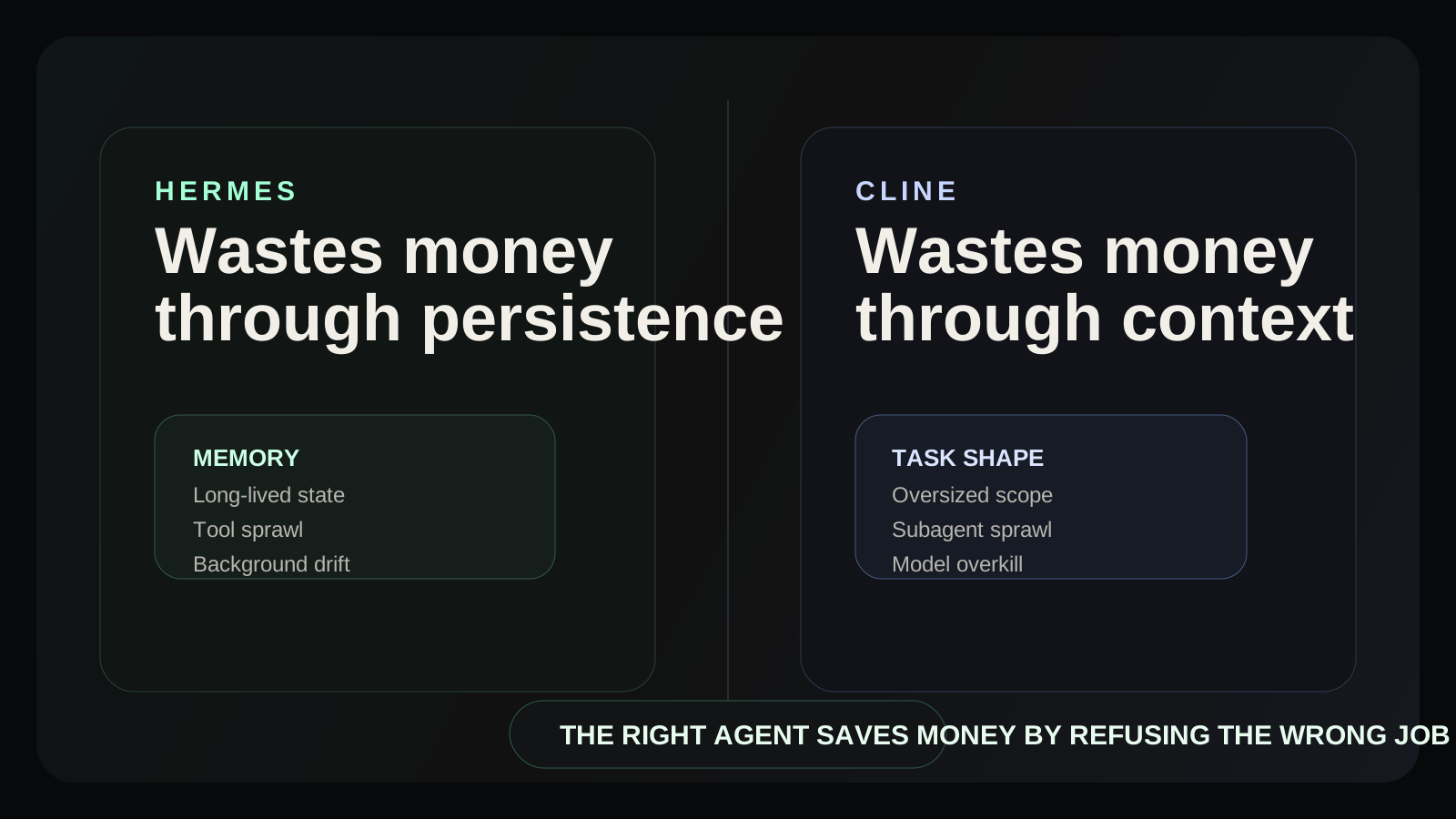
- Hermes tends to waste through persistence, background behavior, and tool sprawl.
- Cline tends to waste through oversized context, vague tasks, and parallel coding work.
- The cheaper tool is usually the one matched to the correct workflow.
- The worst setup is using both with no workload boundaries.
Editorial judgment
The practical stance: Hermes vs Cline is only useful when it is tied to a named owner, a visible workflow, and an accepted outcome.
Problem to watch
The expensive mistake is treating Hermes vs Cline as a generic spend topic instead of asking which behavior, provider, or workflow created the cost.
How to use this page
Hermes and Cline are not expensive in the same way, so teams make bad decisions when they compare them like interchangeable products.
Concrete examples
- Hermes and Cline are not expensive in the same way, so teams make bad decisions when they compare them like interchangeable products.
- Hermes tends to waste through persistence, background behavior, and tool sprawl.
- Use Hermes for persistent agent operations and ongoing system behavior
Decision rules
- Hermes tends to waste through persistence, background behavior, and tool sprawl.
- Cline tends to waste through oversized context, vague tasks, and parallel coding work.
- Use Cline for bounded coding, debugging, and repo-native work
Mistakes to avoid
- Do not treat Hermes vs Cline as a generic topic; tie it to a workflow, owner, and budget decision.
- Do not compare provider costs without checking quality, retries, and accepted outcomes.
- Do not publish a cost recommendation that cannot be connected to a concrete next action.
These tools create two different shapes of waste
Hermes is architecturally closer to a persistent agent runtime. It is built for memory, skills, automation, and ongoing operation. Cline is much more tightly associated with coding tasks, repo context, and step-by-step delivery inside developer workflows.
That means Hermes waste often comes from staying alive too long or touching too many tools. Cline waste often comes from reasoning over too much context or doing too many things in one task. The bill may be called AI spend in both cases, but the failure mode is not the same.
When Hermes is the smarter spend
Hermes wins when persistence is genuinely part of the product or operating need. If you want a long-lived agent with memory, automation, profiles, and broader system behavior, forcing that workload into a narrower coding-centric tool can become awkward and expensive in its own way.
The trap is pretending every task deserves that runtime model. If the work is really just a bounded repo task, Hermes can be too much machine for too little problem.
When Cline is the smarter spend
Cline wins when the job is specific, repo-scoped, and engineering-heavy. Its task model and cost controls become very effective when the work is framed well. But it gets expensive when teams keep everything in one bloated thread and start treating subagents like free labor.
The best teams do not ask which agent is better in the abstract. They decide which failure mode they would rather manage for the workload in front of them.
- Use Hermes for persistent agent operations and ongoing system behavior
- Use Cline for bounded coding, debugging, and repo-native work
- Do not let both tools chase the same workflow without a reason
- Review overlap monthly so the stack does not turn into shadow duplication
Frequently asked questions
Which tool is cheaper, Hermes or Cline?
Neither in the abstract. Hermes usually burns money through persistence and tool sprawl, while Cline usually burns money through context bloat and over-wide tasks.
Should teams use both?
Only if the workload split is clear. Without boundaries, using both often creates duplicated experimentation and duplicated waste.
What is the biggest comparison mistake?
Treating them as the same category of product instead of different runtime shapes with different cost risks.
The right agent saves money mostly by refusing the wrong job
Spendwall helps teams see when AI tool sprawl is producing real value and when it is just multiplying overlapping cost patterns across the stack.