
Hermes Agent is exciting for exactly the same reason it can become expensive. It is not just a chat window. It is a persistent, self-improving agent runtime with memory, skills, browser control, automation hooks, multi-profile support, and growing MCP support. When people ask whether Hermes is costly, they are often asking the wrong question. The better question is what category of cost it unlocks once it stops being a toy and starts behaving like infrastructure.
What to remember
- Hermes cost is architectural, not just per-prompt.
- Persistent memory and background execution change how spend accumulates.
- The hidden bill usually lives in tools, browsers, retries, and automation drift.
- Hermes needs budgets and expiry rules as soon as it becomes operational.
Editorial judgment
The practical stance: Hermes Agent costs is only useful when it is tied to a named owner, a visible workflow, and an accepted outcome.
Problem to watch
The expensive mistake is treating Hermes Agent costs as a generic spend topic instead of asking which behavior, provider, or workflow created the cost.
How to use this page
Hermes does not get expensive because of one prompt. It gets expensive because one agent quietly becomes a whole operating stack.
Concrete examples
- Hermes does not get expensive because of one prompt. It gets expensive because one agent quietly becomes a whole operating stack.
- The expensive part of Hermes is often everything around the model call, not only the model call itself.
- Long-running agents that survive past the original task
Decision rules
- Hermes cost is architectural, not just per-prompt.
- The expensive part of Hermes is often everything around the model call, not only the model call itself.
- Memory stores that keep growing without a review habit
Mistakes to avoid
- Do not treat Hermes Agent costs as a generic topic; tie it to a workflow, owner, and budget decision.
- Do not compare provider costs without checking quality, retries, and accepted outcomes.
- Do not publish a cost recommendation that cannot be connected to a concrete next action.
Why Hermes spend feels different from normal AI chat spend
A normal chat product burns budget in obvious bursts. A Hermes setup is different because the agent stays alive, accumulates memory, manages tasks over time, and can orchestrate tools outside the narrow moment when a human is staring at it.
That changes the cost profile. You are no longer paying only for answers. You are paying for persistence, state, browser sessions, tool calls, automation, and sometimes the human supervision needed to keep the whole thing from drifting into unowned behavior.
That is what makes Hermes strategically interesting and financially dangerous at the same time.
Team takeaway
The expensive part of Hermes is often everything around the model call, not only the model call itself.
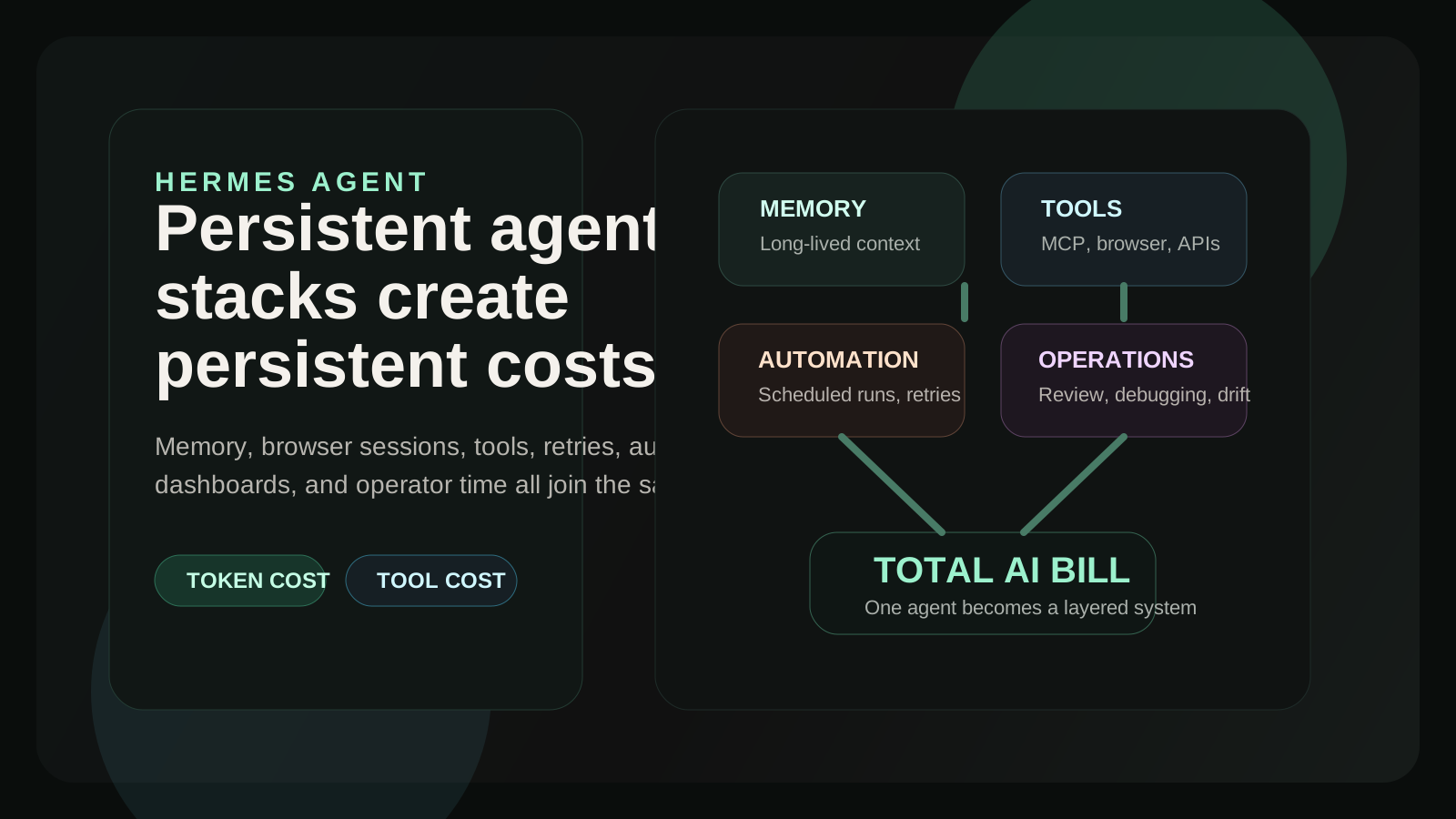
Where the real Hermes bill usually shows up
The visible line item is inference. The less visible line items are browser automation, long-lived memory, MCP-connected tools, failed runs, retries, and profiles or environments that nobody cleaned up after the experiment was supposedly over.
That is why a cheap-looking agent can still be an expensive operational habit. People fixate on the unit price of the model and ignore the fact that a persistent agent runtime creates more opportunities to keep spending without a fresh decision each time.
- Long-running agents that survive past the original task
- Memory stores that keep growing without a review habit
- Browser and tool actions retried because the environment changed
- Parallel experiments across profiles with no aggregate budget view
How to govern Hermes before it becomes a budget sink
Hermes should be treated less like a novelty and more like an internal service. That means owners, budget expectations, narrow use cases, and review dates. If the team cannot say what the agent is allowed to do, how long it can stay alive, and how success gets measured, the spend will get fuzzy fast.
The sharpest early move is simple: classify Hermes workloads. Some deserve persistence and memory. Others should be one-off tasks with hard boundaries. Mixing those two worlds is how teams end up paying premium runtime behavior for work that never needed it.
Frequently asked questions
What makes Hermes Agent expensive in practice?
Usually not one giant prompt. The bigger drivers are persistence, memory growth, browser and tool use, retries, and background behavior that no one retires.
Is Hermes too expensive for small teams?
Not necessarily, but small teams need tighter scope because persistent agents magnify loose habits quickly.
What is the first Hermes safeguard to add?
Assign an owner and define when the agent should stop running or be reviewed.
Persistent agents need persistent budget discipline
Spendwall helps teams understand when AI workflows stop being isolated experiments and start behaving like an always-on operating cost.