
People love saying self-hosted is cheaper. Sometimes it is. The problem is that self-hosted gets framed like a magic trick that erases spending rather than a trade where the bill moves to other categories. Hermes makes that trade especially interesting because it can run on modest infrastructure, but it also invites exactly the kind of persistent behavior that keeps small costs alive all month.
What to remember
- Self-hosted shifts the bill. It does not erase it.
- The cheapest infrastructure choice can still be expensive if the agent runs pointlessly for weeks.
- Inference, storage, browser automation, and operator time all count.
- A lightweight deployment only stays lightweight if workloads are constrained.
Editorial judgment
The practical stance: self-hosted Hermes cost is only useful when it is tied to a named owner, a visible workflow, and an accepted outcome.
Problem to watch
The expensive mistake is treating self-hosted Hermes cost as a generic spend topic instead of asking which behavior, provider, or workflow created the cost.
How to use this page
Self-hosting removes some fees, not the ongoing cost of inference, uptime, storage, tool access, and human supervision.
Concrete examples
- Self-hosting removes some fees, not the ongoing cost of inference, uptime, storage, tool access, and human supervision.
- The economic question is not 'did we avoid the SaaS fee?' It is 'what categories of cost did we just internalize?'
- The host or VPS itself
Decision rules
- Self-hosted shifts the bill. It does not erase it.
- The economic question is not 'did we avoid the SaaS fee?' It is 'what categories of cost did we just internalize?'
- Model inference through APIs or local inference infrastructure
Mistakes to avoid
- Do not treat self-hosted Hermes cost as a generic topic; tie it to a workflow, owner, and budget decision.
- Do not compare provider costs without checking quality, retries, and accepted outcomes.
- Do not publish a cost recommendation that cannot be connected to a concrete next action.
Why self-hosted sounds cheaper than it often is
Self-hosted feels efficient because the monthly seat disappears from view. But what replaces it is a stack of smaller costs: compute, storage, logs, backups, networking, model access, browser environments, and the time someone spends babysitting the setup when it drifts.
Those costs are easy to dismiss one by one. Together they become the real bill. That is especially true when the agent is designed to stay available rather than wake up for one clearly bounded task.
Team takeaway
The economic question is not 'did we avoid the SaaS fee?' It is 'what categories of cost did we just internalize?'
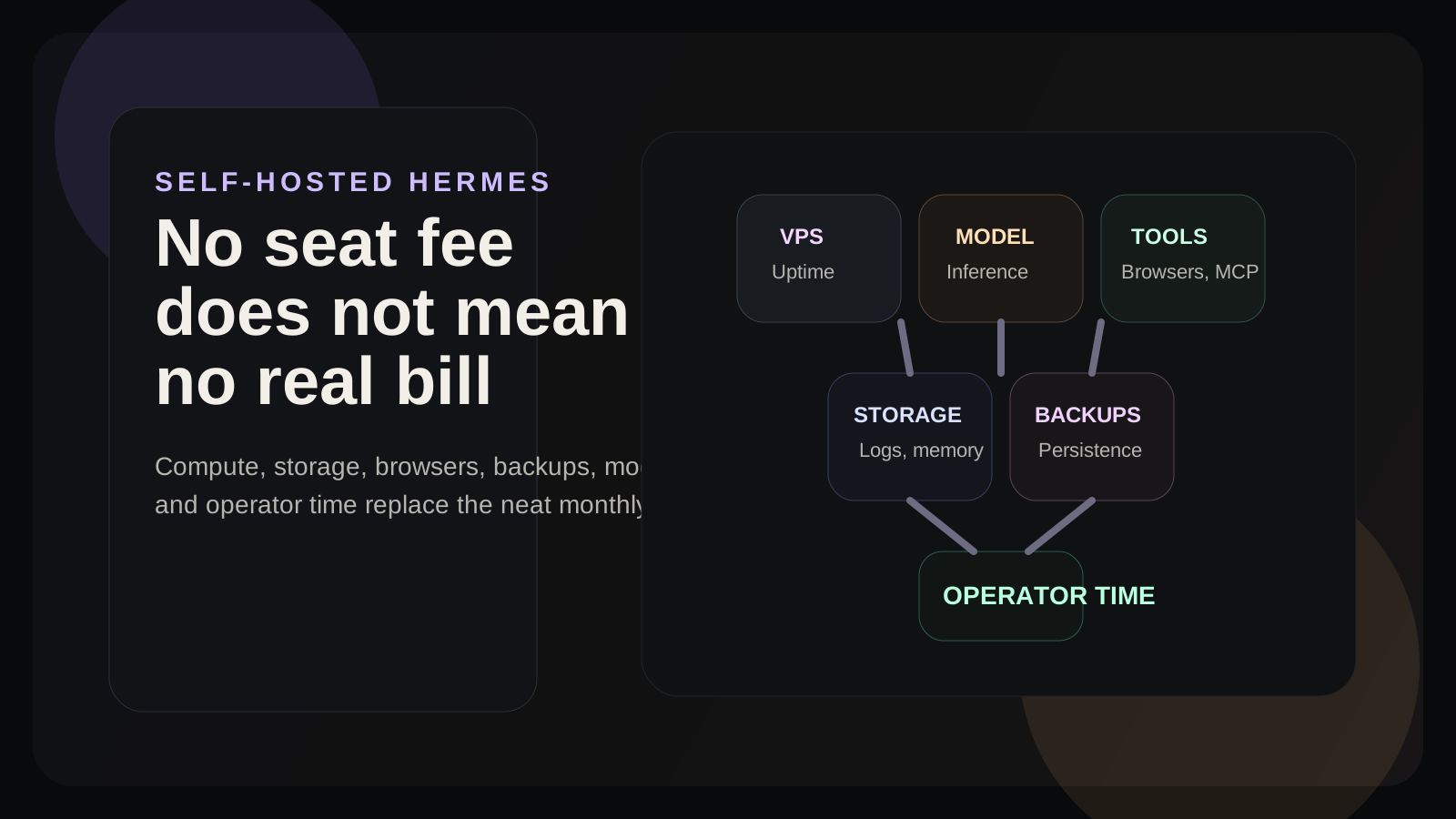
What actually costs money in a self-hosted Hermes setup
A Hermes deployment can be efficient, but only if the team is honest about what they are running. Persistent agent services encourage uptime. Uptime creates logs, storage, dashboards, caches, memory artifacts, and background checks. Then come the tool layers: browsers, MCP servers, external APIs, and any agent workflow that touches another paid system.
None of that means self-hosted is a bad idea. It means cost review has to include everything the agent touches, not just the box it runs on.
- The host or VPS itself
- Model inference through APIs or local inference infrastructure
- Browser or automation environments
- Backups, storage, and memory persistence
- Operator time when the system misbehaves
When self-hosted Hermes is worth it and when it is mostly ego
Self-hosting is worth it when you want control, stable internal workflows, and enough usage to justify the discipline. It is a weak move when the real goal is just avoiding a seat fee while keeping all the same loose habits.
The healthy test is simple. If the team still has no workload limits, no owner, and no weekly review, then self-hosting is probably just moving the waste somewhere harder to see.
Frequently asked questions
Can Hermes really run cheaply when self-hosted?
Yes, but only if the workloads are narrow and the agent is not left running aimlessly with growing tool and memory overhead.
What cost gets ignored most in self-hosted agent setups?
Operator time. Someone always ends up maintaining, debugging, and reviewing the system.
What is the first self-hosted rule to add?
Time-box the workloads and review uptime. An always-on agent should justify staying on.
Self-hosted agents only save money when the operating model is tighter than the hype
Spendwall helps teams see the full operating picture around AI workflows so hidden costs do not disappear just because they moved off the invoice they used to watch.