Cline is one of the most interesting agentic coding tools because it can do real work across files, tools, terminals, and MCP servers. That also means it can waste money in surprisingly ordinary ways. The expensive Cline workflow is usually not a sign of ambition. It is a sign that the task was too broad, the context was too noisy, or the team never bothered to trim what Cline was allowed to see.
What to remember
- Most Cline waste comes from task scope and context hygiene, not from one bad answer.
- `.clineignore` and smaller task boundaries are cost controls, not minor configuration details.
- Auto compact helps, but it cannot rescue a badly framed workflow forever.
- Subagents are powerful and should be budgeted like parallel work, not like free assistance.
Editorial judgment
The practical stance: reduce Cline token usage is only useful when it is tied to a named owner, a visible workflow, and an accepted outcome.
Problem to watch
The expensive mistake is treating reduce Cline token usage as a generic spend topic instead of asking which behavior, provider, or workflow created the cost.
How to use this page
Cline gets costly when people use full-repo context and open-ended tasks where a smaller bounded task would have done the job.
Concrete examples
- Cline gets costly when people use full-repo context and open-ended tasks where a smaller bounded task would have done the job.
- The fastest Cline savings usually come from refusing to make every task a giant context-management problem.
- Trim irrelevant files with `.clineignore`
Decision rules
- Most Cline waste comes from task scope and context hygiene, not from one bad answer.
- The fastest Cline savings usually come from refusing to make every task a giant context-management problem.
- Break work into smaller task units
Mistakes to avoid
- Do not treat reduce Cline token usage as a generic topic; tie it to a workflow, owner, and budget decision.
- Do not compare provider costs without checking quality, retries, and accepted outcomes.
- Do not publish a cost recommendation that cannot be connected to a concrete next action.
Why Cline costs creep up faster than people expect
Cline feels productive because it can carry momentum through a task. The downside is that people start treating one task like five tasks. They leave giant files in scope, pile on new objectives, and ask the agent to keep reasoning over a repo view that no longer matches the work being asked for.
Once that becomes normal, token use grows quietly. The bill is not being driven by intelligence. It is being driven by broad framing and repetitive context.
The fastest ways to cut Cline spend this week
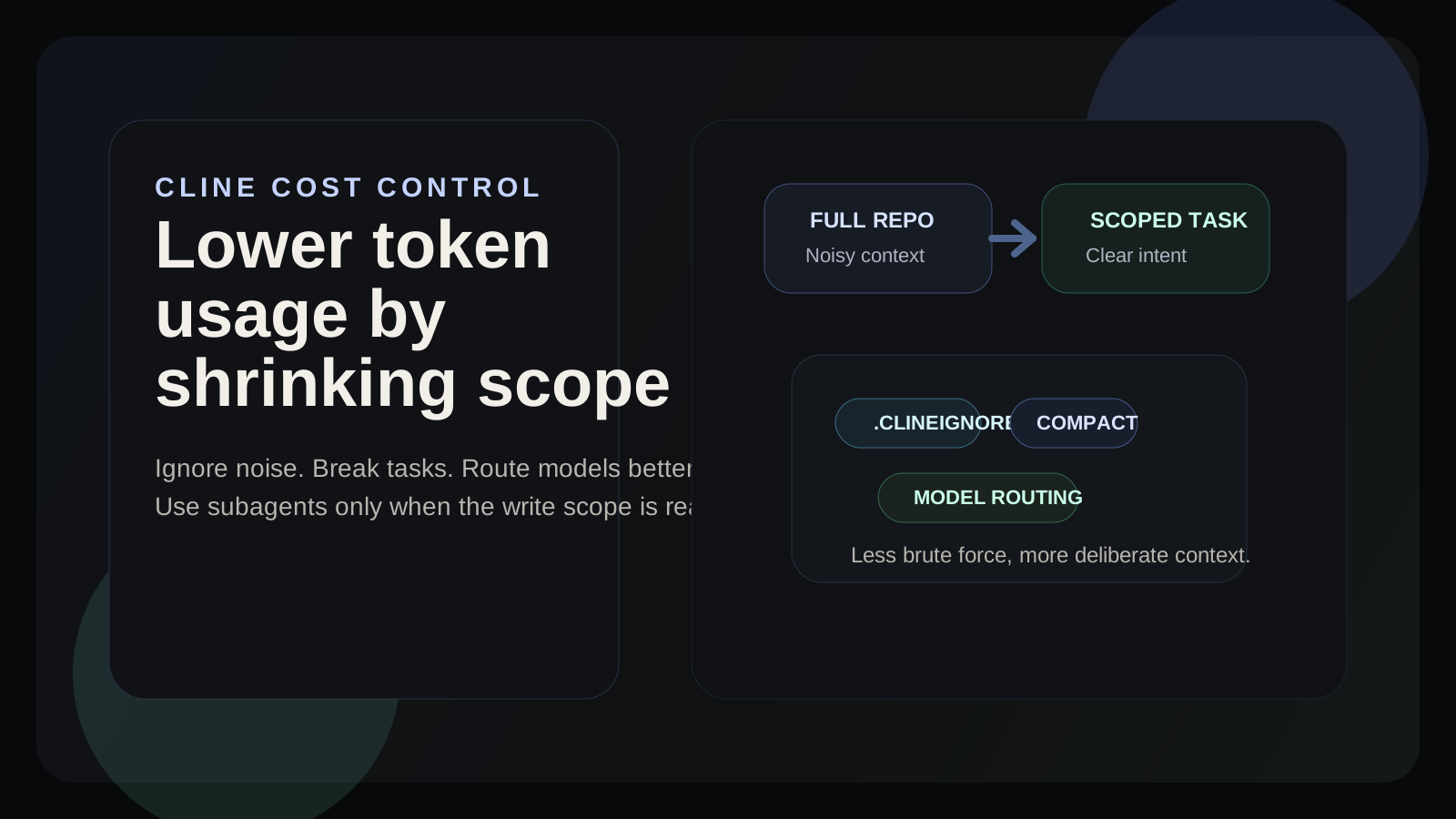
The first win is context hygiene. Use `.clineignore` aggressively for generated files, logs, vendor folders, and anything that should never ride along in normal coding work. The second win is task hygiene: stop asking one thread to design, implement, debug, and refactor all at once.
Then look at model routing. Not every task needs the most expensive model. Some tasks need a strong model for planning and a cheaper one for repetitive execution. Cost control starts feeling real when model choice follows task class instead of habit.
- Trim irrelevant files with `.clineignore`
- Break work into smaller task units
- Use auto compact as support, not as a substitute for discipline
- Reserve expensive models for high-judgment work
Team takeaway
The fastest Cline savings usually come from refusing to make every task a giant context-management problem.
Subagents and model mix are where good teams separate from messy ones
Subagents are a gift and a trap. They are fantastic when the work is clearly bounded. They are expensive chaos when people spawn them just because the tooling makes it easy. Parallelism multiplies both productivity and waste.
The more mature pattern is simple: use stronger models for decisions, cheaper models for bounded execution, and subagents only where the write scope and objective are explicit. That is how you keep Cline useful without turning it into a background budget leak.
Frequently asked questions
What reduces Cline cost fastest?
Narrower tasks, better ignore rules, and better model selection usually beat trying to micromanage output length.
Is auto compact enough to control Cline spending?
No. It helps, but it cannot compensate for tasks that are too broad or noisy to begin with.
Are subagents worth the extra spend?
Yes when they are tightly bounded. No when they are used as a lazy way to throw more work at the system without clear ownership.
A leaner Cline workflow usually writes better code too
Spendwall helps teams review AI-heavy engineering workflows with enough visibility to see whether productivity gains are coming from focus or from brute-force spending.