
The lazy version of the story is easy: American AI is getting expensive, Chinese AI is getting cheap, therefore every buyer should chase the cheapest million tokens. I do not buy it. Cheap inference is a distribution weapon, not a complete product strategy. The real question is whether a provider can keep price low while still delivering capacity, reliability, frontier quality, data governance, and enough infrastructure to survive serious production demand.
What to remember
- The US price signal is not only inflation. It is a shift toward premium agentic work, longer runs, and higher-value autonomy.
- Chinese providers are forcing a brutal price comparison, especially through DeepSeek, Qwen, Kimi, and open-weight distribution.
- The Chinese advantage is price and adoption velocity; the weakness is still infrastructure depth, chip access, and production consistency.
- The right buyer response is not blind migration. It is provider routing by workload, quality threshold, latency, governance, and cost per accepted outcome.
Editorial judgment
Falling Chinese token prices should change model routing, but they should not be treated as proof that every production workload should move away from US frontier providers.
Problem to watch
The cheapest token can be the wrong buy when the workload needs dependable capacity, auditability, latency, or strong tool behavior; the expensive token can be the right buy only when the outcome is measured.
How to use this page
Founders and CTOs can see Chinese API prices collapsing, but they still have to defend reliability, security, and production quality when the model becomes part of a customer workflow.
Concrete examples
- A support automation team can test a cheaper Chinese model for draft classification before using it in customer-facing replies.
- A finance lead can compare provider spend only after separating cheap batch inference from premium agentic coding runs.
- A CTO can route internal summarization to lower-cost models while keeping regulated decisions on providers with stronger enterprise controls.
Decision rules
- The US price signal is not only inflation. It is a shift toward premium agentic work, longer runs, and higher-value autonomy.
- Cheap tokens win only when the quality, latency, governance, and capacity are good enough for the job. Otherwise they just move the cost into retries and supervision.
- Use cheaper tiers for classification, extraction, rewriting, and low-risk bulk tasks.
Mistakes to avoid
- Do not frame the story as China good, America bad.
- Do not confuse token pricing with total workflow cost.
- Do not imply infrastructure constraints make Chinese progress irrelevant.
The wrong reading is that cheap tokens automatically win
Token price is visible, so people overrate it. A public pricing table gives everyone a clean number to screenshot: input per million, output per million, cached input, batch discount. That makes the market feel more rational than it actually is.
The hard part is that a token is not a unit of business value. A million tokens from a model that handles the task cleanly is not equivalent to a million tokens from a model that needs retries, human cleanup, or a second provider to verify the answer. The invoice sees tokens. The team experiences outcomes.
That is why the US-China comparison is dangerous when it becomes a spreadsheet religion. DeepSeek can publish extremely aggressive API prices. Qwen can push a broad open model family through Alibaba Cloud. Kimi can make long-context and agentic coding look shockingly affordable. Those facts matter. They do not erase the operational question: can the provider support the workload you are actually about to move?
Team takeaway
Cheap tokens win only when the quality, latency, governance, and capacity are good enough for the job. Otherwise they just move the cost into retries and supervision.
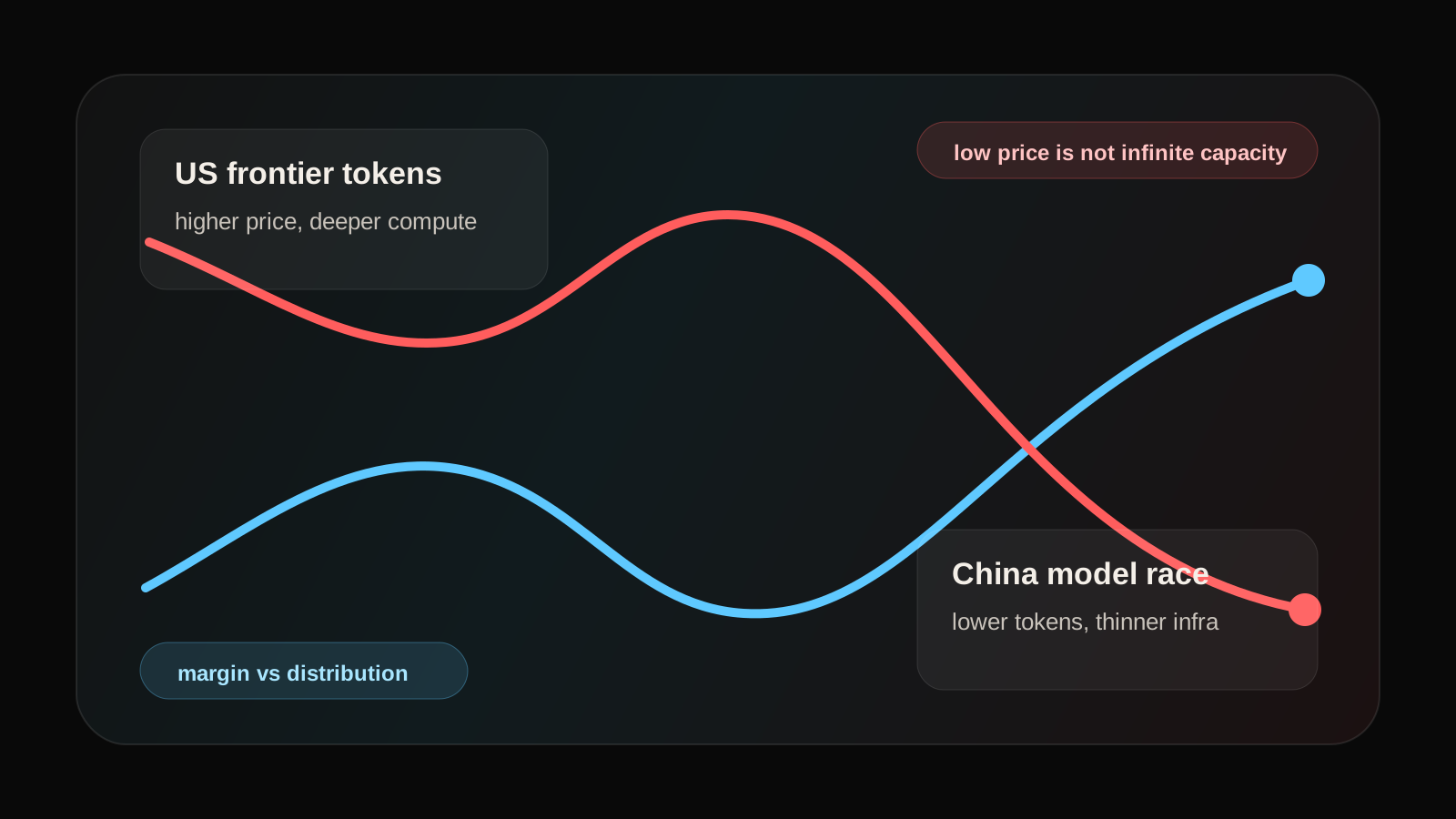
China is turning low price into a strategic weapon
DeepSeek's official API pricing is the cleanest symbol of the pressure: DeepSeek-V3.2 is listed at $0.28 per million input tokens on a cache miss, $0.028 on a cache hit, and $0.42 per million output tokens. That is not a polite discount. It is a direct attack on the assumption that capable model access has to be expensive.
Alibaba's Qwen family is applying pressure differently. Qwen is not just a cheap API line; it is an ecosystem strategy. Alibaba Cloud lists Qwen3 Max international pricing from $1.20 input and $6 output for smaller contexts, with batch and cache mechanics around it. More importantly, Qwen's open-weight footprint makes the model family show up in developer workflows far beyond Alibaba's own console.
Moonshot's Kimi is another important signal. Kimi's platform currently presents K2.6, K2.5, and K2 variants with long context, agentic and coding positioning, and prices that are visibly lower than many premium Western defaults. Baidu and ByteDance matter too, even when their international developer story is less clean: they have distribution, domestic product surfaces, and a reason to push inference cost down until adoption becomes the point.
Team takeaway
China is not merely selling cheaper tokens. It is trying to make the default expectation of inference cost collapse.
The companies advancing are advancing in different directions
OpenAI is advancing through frontier models, agentic workflows, coding capability, multimodal systems, and a product surface that can monetize autonomy. Anthropic is advancing through high-trust enterprise and coding handoff work, with a pricing structure that clearly asks buyers to reserve the strongest models for the hardest tasks. Google is advancing through distribution, free-tier pressure, long context, and very cheap Flash-class models that make high-volume experimentation easier.
On the Chinese side, DeepSeek is advancing through brutal efficiency and price shock. Alibaba is advancing through Qwen's open model footprint, cloud packaging, coding capability, and rapid model family expansion. Moonshot is advancing through Kimi's long-context, agentic, and coding positioning. Baidu has a domestic platform advantage with ERNIE, while ByteDance has distribution power through consumer products and Doubao-style usage loops.
This is why the market is hard to read. The winner in enterprise coding might not be the winner in consumer chat. The winner in low-cost batch inference might not be the winner in regulated enterprise data. The winner in China may be limited internationally by trust, compliance, or infrastructure. The winner in the US may be too expensive for workflows where 'good enough and cheap' is the correct answer.
- OpenAI: premium autonomy, coding, multimodal, agentic product depth.
- Anthropic: high-trust reasoning, coding handoff, enterprise workflows.
- Google: long context, cheap Flash tiers, free-tier developer reach.
- DeepSeek: cost shock, efficiency narrative, open model gravity.
- Alibaba Qwen: open-weight distribution, cloud packaging, coding and multilingual reach.
- Moonshot Kimi: long-context and agentic coding momentum.
- Baidu and ByteDance: domestic distribution and product embedding.
China's infrastructure gap is the part the price chart hides
The Chinese progress is real, and dismissing it is lazy. DeepSeek, Qwen, and Kimi changed the emotional baseline for what a strong model should cost. But the infrastructure constraint is also real. Export controls, limited access to the newest Nvidia systems, domestic chip substitution, offshore training workarounds, and uneven production capacity all matter once usage moves from demo to sustained workload.
This is the uncomfortable tradeoff: China can be excellent at making models cheaper and more widely available, while still being behind in the infrastructure stack that lets a frontier lab iterate quickly, serve global enterprise traffic, and keep the strongest models reliable under pressure. Huawei Ascend, Cambricon, and domestic data center buildout are strategically important, but they do not magically erase the advantage of deeper Nvidia-centered infrastructure in the US cloud ecosystem.
That gap does not make Chinese models irrelevant. It makes them more interesting. A constrained ecosystem has to get better at efficiency because it cannot always brute-force the problem. The danger for US labs is that the constraint becomes a forcing function. The danger for Chinese labs is that efficiency alone cannot replace dependable global capacity.
Team takeaway
The Chinese model race is impressive precisely because it is happening under infrastructure pressure. That pressure creates efficiency, but it also creates ceilings.
The buyer playbook is routing, not ideology
A serious team should not turn this into a flag argument. The right question is boring and useful: which workload belongs where? Some work deserves OpenAI, Anthropic, or Google because failure is expensive, governance is strict, or the model has to use tools reliably. Some work deserves DeepSeek, Qwen, Kimi, or another low-cost model because volume matters more than the last few points of frontier capability.
The routing layer is where the money gets saved. Use premium models for high-judgment tasks. Use cheap models for drafts, extraction, classification, first-pass analysis, and internal tools where a second check is cheap. Use batch and cache whenever latency is not the product. Use source-aware evaluation before moving regulated or customer-facing workflows.
The worst move is to pick one provider as a belief system. The second-worst move is to use every provider with no ownership. A multi-provider stack is only mature when the team can explain why each provider is there, what workload it owns, how quality is measured, and when cost alerts fire.
- Route by workload class: premium, cheap, batch, cached, experimental, regulated.
- Compare cost per accepted outcome, not table price alone.
- Keep provider-level alerts because each provider fails and bills differently.
- Review model mix monthly; price changes are now a product event, not a finance footnote.
The Spendwall angle is simple: the blended bill is where truth lives
This price war makes Spendwall more relevant, not less. The more providers a team uses, the less useful any single provider dashboard becomes. OpenAI can tell you OpenAI usage. DeepSeek can tell you DeepSeek usage. Alibaba can show Model Studio usage. None of them naturally explains whether your whole AI stack is becoming healthier.
The blended bill is where truth lives: which provider is growing, which project caused the movement, whether cheap-model migration actually reduced accepted-outcome cost, and whether premium-model usage is attached to work that justifies the spend.
That is the position I would take as a buyer: celebrate falling token prices, but do not confuse them with cost control. Cost control starts when someone can see the whole model mix and make a decision before the invoice turns into a surprise.
Frequently asked questions
Are Chinese AI models simply cheaper than US models now?
Often yes on public token pricing, especially for DeepSeek and several Qwen or Kimi options. But cheaper token pricing does not automatically mean lower production cost once reliability, quality, latency, governance, and retries are included.
Why are some US token prices rising?
The premium US model tiers are increasingly priced around agentic work, coding, long-context reasoning, tool use, and enterprise reliability. Buyers are not only paying for text generation; they are paying for models that can handle more expensive work.
What is China's biggest AI advantage right now?
Price pressure and open model distribution. DeepSeek, Qwen, Kimi, Baidu, and ByteDance are making capable AI feel cheaper and more available, which puts pressure on Western margins.
What is China's biggest constraint?
Infrastructure depth. Chip access, domestic accelerator maturity, data center capacity, and global enterprise serving reliability still shape how far low pricing can stretch in production.
How should teams choose between US and Chinese model providers?
Use routing instead of ideology. Keep premium US models for high-risk, high-judgment, verifiable work, and test lower-cost Chinese models for high-volume or lower-risk workflows where quality gates and fallback paths are clear.
A price war makes provider visibility non-negotiable
Spendwall helps teams compare model providers by project, owner, and workflow so cheap tokens and premium runs can be judged by what they actually do to the blended AI bill.