The most interesting thing about GPT-5.5 is not that it is smarter. Smarter is table stakes now. The interesting part is that OpenAI is pushing the model toward a different operating mode: less line-by-line instruction, more durable task ownership. That sounds like productivity. It also quietly changes the unit of cost from 'a prompt' to 'a run.'
What to remember
- GPT-5.5 shifts cost control from prompt hygiene to run governance.
- The expensive failure mode is not a bad answer. It is a good agent that keeps working past the value line.
- Teams should measure cost per accepted outcome, not only input and output tokens.
- GPT-5.5 belongs behind budgets, tool policies, and stop conditions from day one.
Editorial judgment
The practical stance: ChatGPT 5.5 cost control is only useful when it is tied to a named owner, a visible workflow, and an accepted outcome.
Problem to watch
The expensive mistake is treating ChatGPT 5.5 cost control as a generic spend topic instead of asking which behavior, provider, or workflow created the cost.
How to use this page
GPT-5.5 can carry more of the work itself, which means teams need to budget the whole agent run instead of only watching per-token pricing.
Concrete examples
- GPT-5.5 can carry more of the work itself, which means teams need to budget the whole agent run instead of only watching per-token pricing.
- The better the model gets at continuing, the more important it becomes to decide when continuation is no longer worth paying for.
- Track cost per completed task, not only cost per request.
Decision rules
- GPT-5.5 shifts cost control from prompt hygiene to run governance.
- The better the model gets at continuing, the more important it becomes to decide when continuation is no longer worth paying for.
- Separate accepted runs from abandoned runs.
Mistakes to avoid
- Do not treat ChatGPT 5.5 cost control as a generic topic; tie it to a workflow, owner, and budget decision.
- Do not compare provider costs without checking quality, retries, and accepted outcomes.
- Do not publish a cost recommendation that cannot be connected to a concrete next action.
The important change is behavioral, not just benchmark-shaped
A lot of launch coverage will orbit the table: coding scores, browse scores, math scores, latency, context, price. Those numbers matter, but they are not the most useful way to think about GPT-5.5 inside a company.
The more practical shift is behavioral. GPT-5.5 is designed to understand the task earlier, move across tools, check work, and keep going. In other words, it is not merely a better text generator. It is a more convincing worker-shaped system.
That changes how waste appears. With weaker models, waste was often visible: repeated prompts, hallucinated answers, obvious corrections. With stronger agentic models, waste can look like progress for much longer. The model edits files, reads docs, opens tools, tries another path, and produces something that looks serious. The invoice meter keeps moving while everyone is impressed.
Team takeaway
The better the model gets at continuing, the more important it becomes to decide when continuation is no longer worth paying for.
The new cost unit is the accepted run
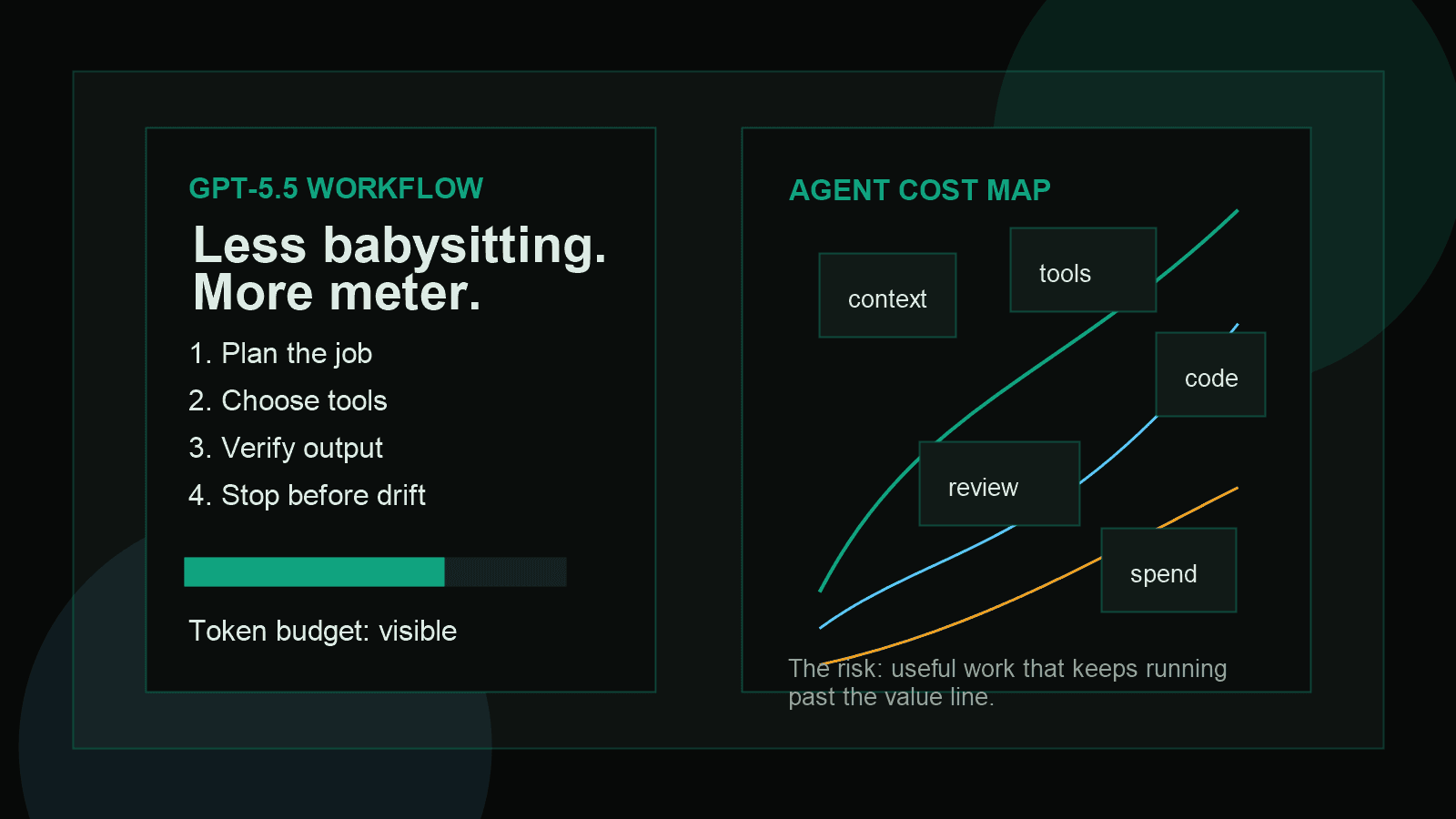
Per-token pricing is still real, especially once GPT-5.5 and GPT-5.5 Pro are used through APIs. But token pricing is too small a lens for agentic work. A team does not buy tokens because it enjoys tokens. It buys a fixed bug, a cleaned spreadsheet, a researched decision, a deployed patch, a reconciled vendor bill.
That means the metric to watch is cost per accepted run: how much did the model spend from first instruction to accepted output? How many tools did it call? How many times did it re-read the same files? How often did a human reject the final answer and restart the job?
A cheaper model can be more expensive if it needs three restarts. A more expensive model can be cheaper if it lands the task cleanly. GPT-5.5 makes that tradeoff sharper because it is more capable of doing real work end to end.
- Track cost per completed task, not only cost per request.
- Separate accepted runs from abandoned runs.
- Measure tool-call count and repeated context reads.
- Attach spend to owner, project, and provider before rollout.
For Codex, the quiet question is supervision density
The most practical GPT-5.5 use case is coding. Not because coding is glamorous, but because coding has a natural audit trail: diffs, tests, logs, commits, failures. That makes it easier to know whether an expensive model run created value.
The trick is supervision density. If GPT-5.5 lets an engineer hand over a messy refactor and check back later, the value can be enormous. But only if the run is bounded. Which files can it touch? Which tests prove success? How long should it investigate before asking for direction? What should it never change without confirmation?
The teams that win will not be the ones that simply switch the model selector to GPT-5.5. They will be the ones that redesign their coding workflow around verifiable delegation.
Team takeaway
A stronger coding model is not a license to remove process. It is a reason to make the process machine-readable.
The pricing trap is comparing GPT-5.5 to GPT-5.4 in isolation
The obvious spreadsheet says: here is the new price, here is the old price, here is the delta. That spreadsheet is useful and incomplete. GPT-5.5 should be compared against a workflow, not only against GPT-5.4.
If a support analyst uses GPT-5.5 for a 30-second rewrite, the model may be overkill. If an engineer uses it to resolve a multi-file issue that would have consumed an afternoon, the model can be a bargain. The same price can be silly or cheap depending on the job boundary.
This is why teams need routing rules. Use frontier models where the task has expensive ambiguity, durable value, or verification loops. Use cheaper models where the task is small, reversible, or already well structured.
A sane GPT-5.5 rollout needs budgets, not vibes
The right rollout is not a blanket ban and not a free-for-all. It is a tiered policy: approved use cases, per-project caps, owner-level visibility, and alerting on abnormal run behavior.
The best first budget is not monthly spend. It is a run budget. For example: one investigation can use this much context, this many tool calls, this much wall-clock time, and this set of approved tools before it must summarize and ask for a decision.
That may sound bureaucratic, but it is actually what makes agentic AI usable at scale. Nobody wants to approve every prompt. Everybody wants to know the agent is not wandering through the budget because the task definition was sloppy.
- Set maximum spend per run for high-autonomy tasks.
- Route GPT-5.5 to complex, verifiable work first.
- Alert on repeated tool calls, long runs, and abandoned outputs.
- Review cost per accepted outcome weekly during rollout.
Team takeaway
GPT-5.5 deserves a rollout plan that treats autonomy as a budgeted resource.
Frequently asked questions
Is GPT-5.5 automatically more expensive to use?
Not automatically. The unit economics depend on the whole workflow. If GPT-5.5 completes difficult work with fewer restarts and less human correction, the cost per accepted outcome can improve even when per-token pricing is higher.
What should teams measure first after enabling GPT-5.5?
Measure cost per accepted run, abandoned run rate, tool-call count, repeated context reads, and spend by project or owner. Those reveal whether autonomy is creating value or just more activity.
Should GPT-5.5 be the default model for every employee?
Usually no. It should be routed to high-value work with ambiguity, verification needs, or expensive human time. Smaller tasks should stay on cheaper models unless quality failures make them more expensive in practice.
Frontier models need frontier cost visibility
Spendwall helps teams see which providers, projects, and workflows are driving spend so GPT-5.5 adoption turns into leverage instead of another invisible line item.