Claude Opus 4.7 is interesting because it sits in a very specific emotional gap for engineering teams: the work you do not want to micromanage, but also cannot afford to trust blindly. That is where frontier coding models are becoming genuinely useful. Not as autocomplete. Not as a magic teammate. As a handoff surface with evidence.
What to remember
- Opus 4.7 is most compelling where tasks are hard enough to justify a serious model run.
- The winning pattern is not blind delegation. It is handoff plus evidence.
- Better vision makes UI, slide, and document review more valuable, but also easier to overuse.
- Teams should meter Opus work by accepted handoff, not by chat session.
Editorial judgment
The practical stance: Claude Opus 4.7 coding costs is only useful when it is tied to a named owner, a visible workflow, and an accepted outcome.
Problem to watch
The expensive mistake is treating Claude Opus 4.7 coding costs as a generic spend topic instead of asking which behavior, provider, or workflow created the cost.
How to use this page
Opus 4.7 makes harder work easier to hand off, but high-trust delegation needs cost checkpoints and acceptance gates.
Concrete examples
- Opus 4.7 makes harder work easier to hand off, but high-trust delegation needs cost checkpoints and acceptance gates.
- A coding model becomes economically useful when it reduces supervision without erasing accountability.
- Use Opus for ambiguous, multi-step, high-cost work.
Decision rules
- Opus 4.7 is most compelling where tasks are hard enough to justify a serious model run.
- A coding model becomes economically useful when it reduces supervision without erasing accountability.
- Require a test or evidence trail for coding tasks.
Mistakes to avoid
- Do not treat Claude Opus 4.7 coding costs as a generic topic; tie it to a workflow, owner, and budget decision.
- Do not compare provider costs without checking quality, retries, and accepted outcomes.
- Do not publish a cost recommendation that cannot be connected to a concrete next action.
The interesting part is not that Opus 4.7 is smarter
Every frontier release arrives with a familiar promise: better coding, better reasoning, better instruction following. Opus 4.7 has those claims. Anthropic is especially explicit about hard software engineering and long-running work.
But the useful product question is more grounded: does this model make a handoff safer? Can you give it a difficult task, leave it room to reason, and get back not just an answer, but evidence that the answer deserves review?
That is where Opus 4.7 becomes interesting. It is not about replacing engineering judgment. It is about moving some of the expensive middle work out of the human's head and into a system that can produce a trail: plan, edits, tests, caveats, screenshots, comparisons, open questions.
Team takeaway
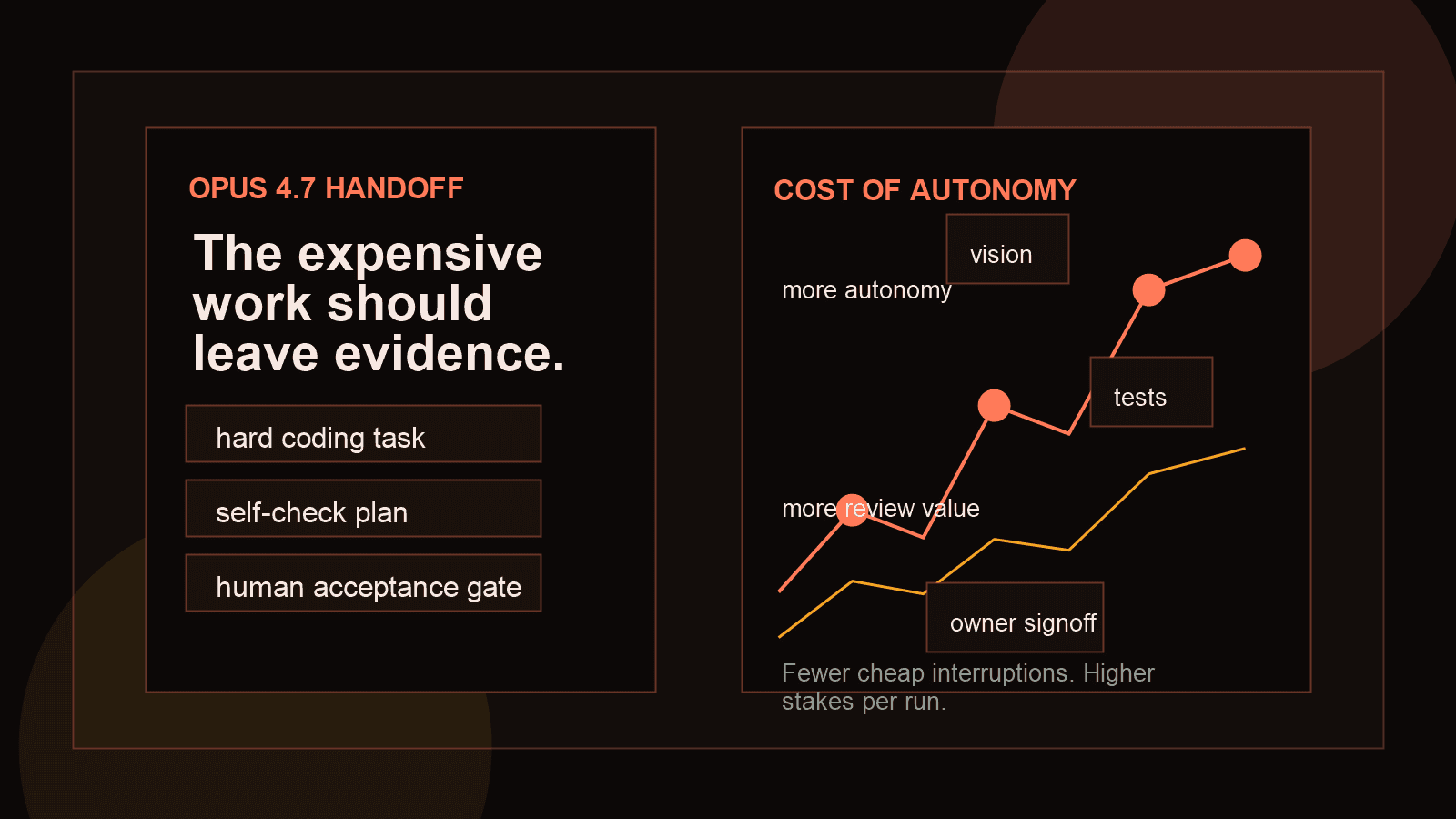
A coding model becomes economically useful when it reduces supervision without erasing accountability.
The economics of handoff are different from the economics of chat
Chat pricing encourages people to think in prompts. Handoff work should be priced mentally in outcomes. If Opus 4.7 spends more per run but saves a senior engineer from two hours of tangled investigation, that can be a clean win. If it is used for lightweight copy edits, it may be theatrical spending.
This is the uncomfortable truth about premium models: they are often cheapest when used on expensive problems. They are often most wasteful when used casually because the interface makes powerful reasoning feel as available as spellcheck.
The practical move is to create a handoff threshold. Below that threshold, use faster and cheaper models. Above it, use Opus 4.7 with explicit acceptance criteria.
- Use Opus for ambiguous, multi-step, high-cost work.
- Require a test or evidence trail for coding tasks.
- Avoid using premium runs for low-stakes transformations.
- Measure accepted handoffs, not raw messages.
Better vision changes UI review more than people think
Anthropic called out better vision and higher-resolution image understanding. That matters for a class of work that teams routinely under-measure: visual QA, interface critique, slide review, screenshot analysis, design-to-code comparison.
This is not just a designer feature. Engineering teams lose a surprising amount of time to visual ambiguity. Is the chart clipped? Is the empty state readable? Does the dashboard communicate priority? Are the controls aligned? A model that can inspect visual output with more precision can shorten the loop.
The cost trap is that visual review can become endless. A model can always find another polish issue. That is why visual Opus work needs a definition of done: accessibility, overlap, obvious layout failures, critical copy, and domain-specific correctness.
Team takeaway
Vision-capable review should end at a shipping standard, not at infinite taste refinement.
Rigor is the feature that determines whether teams trust the bill
Anthropic's framing around rigor and self-verification is important because cost control is not only about spending less. It is about being able to defend the spend. A model run that produces a patch plus the commands it ran plus the remaining risks is much easier to justify than a beautiful paragraph that says everything is fine.
For managers, this changes the review conversation. The question becomes: did the model provide enough evidence for the human to make a faster decision? If yes, the run created leverage. If no, the run generated more material to audit.
The best Opus 4.7 workflows will ask for receipts by default: test output, changed files, assumptions, tradeoffs, screenshots, and known unknowns.
A good Opus 4.7 policy is boring on purpose
The policy should be simple: reserve Opus for hard handoffs, require evidence, cap run budgets, and attach every expensive run to a project or owner. That sounds plain because it should be plain. The danger with frontier models is that teams treat them like a special occasion instead of an operating system cost.
A boring policy is what lets people use the model confidently. Engineers know when to reach for Opus. Managers know what evidence should come back. Finance can see which projects are turning premium model spend into shipped work.
That is how Opus 4.7 becomes an advantage instead of an exciting new fog machine for the budget.
- Define which tasks qualify for Opus handoff.
- Require acceptance criteria before the run starts.
- Store evidence with the task, not only inside chat history.
- Alert on repeated premium runs for the same unresolved issue.
Team takeaway
The more capable the model, the more boring the operating policy should become.
Frequently asked questions
Is Claude Opus 4.7 best for every coding task?
No. It is most valuable for difficult, ambiguous, or long-running coding tasks where better reasoning and self-verification can reduce human supervision. Small routine edits should usually stay on cheaper or faster models.
How should teams control Opus 4.7 costs?
Track cost per accepted handoff, require evidence for premium coding runs, set project-level budgets, and alert when the same task triggers repeated high-cost attempts.
Does better vision make Opus 4.7 useful outside coding?
Yes. Better vision can help with UI review, screenshot QA, slide feedback, and document analysis, but teams should set review boundaries so visual critique does not become endless polish spend.
Premium model work should leave a clean cost trail
Spendwall gives teams the project, provider, and alerting layer needed to understand when Claude Opus runs are turning into shipped work and when they are drifting into expensive investigation.